
Winona City Directory Shelves
Winona's historical shelf is shared by two local institutions. The Winona County Historical Society, or WCHS, describes a run from 1866 to the present, while Winona Public Library, or WPL, reports directories from 1872 to the present with missing years. Those descriptions establish strong local coverage, but neither one proves that every calendar year or every final printed edition is on hand. Start with the year closest to the event, write down the title and publisher, and then ask the holding institution about the particular volume.
| Collection | Years | Where Held | Access |
|---|---|---|---|
| Winona city directories | 1866-present at Winona County Historical Society; 1872-present at Winona Public Library, with gaps | Winona County Historical Society and Winona Public Library | On-site research; volume and page-image availability varies |
| Named early publisher editions | 1866-1890; Winona Directory Company, 1901-1941 | Historic bibliography and local Winona Public Library or Winona County Historical Society copies | Use the year and publisher to request a volume |
| Local newspaper holdings | 1855-present holdings; digitized material, 1855-1976 | Winona OpenRiver, Winona Public Library microfilm, and Winona County Historical Society | Free online search or browse; microfilm and archive channels also apply |
| Obituary indexes | 1960-1979, 1980-1999, and 2000-2010 | Winona Public Library | Limited staff-request indexes, not complete runs |
| State census material | 1865, 1875, 1885, 1895, and 1905 | Minnesota Historical Society | Genealogy gateway and archival research |
The Winona collection descriptions use broad end dates, not a promise of uninterrupted publication. The final printed-directory year was not established in the available official research, so a missing recent year should be checked with Winona Public Library or Winona County Historical Society instead of assumed to be the end of the series.
Winona Directory Publishers by Year
The earliest identified volume is the 1866 Winona Directory credited to John M. Wolf and A. Bailey. Publisher names changed frequently through 1890. That variation matters when an archive catalog places a volume under a publisher instead of a street name or a later series title. Winona Directory Company then produced the editions identified for 1901 through 1941. A careful request includes the suspected year and, where known, the publisher.
- 1866: John M. Wolf and A. Bailey issued the first identified directory.
- 1872-1890: D. Sinclair & Co., Campbell, Russell & Bardwell, Morrissey & Bunn, J. V. Bunn, and Jones & Kroeger appear in the documented early editions.
- 1901-1941: the documented Winona Directory Company run follows those changing early imprints.
- Later years: Winona Public Library and Winona County Historical Society describe continuing holdings, but the research does not establish the last printed issue.
Publisher changes are a useful comparison point. A name that fails in a later title may be present in an earlier volume cataloged under a different imprint. Note: Treat a catalog date as a starting point, then confirm the physical volume and its printed title page.
Winona Newspapers Beside Directories
A Winona directory gives a compact yearly snapshot. Newspapers can add an announcement, a business notice, a death notice, or a move that explains a change between editions. Winona Public Library holds Winona newspaper microfilm from July 19, 1860 to the present. Winona State University's OpenRiver archive offers keyword and issue browsing across four digitized papers from 1855 through 1976. The digital collection is valuable, though its OCR can miss names and some issues are absent.
The OpenRiver Winona newspaper archive shows the browse and search route used for the digitized local papers.
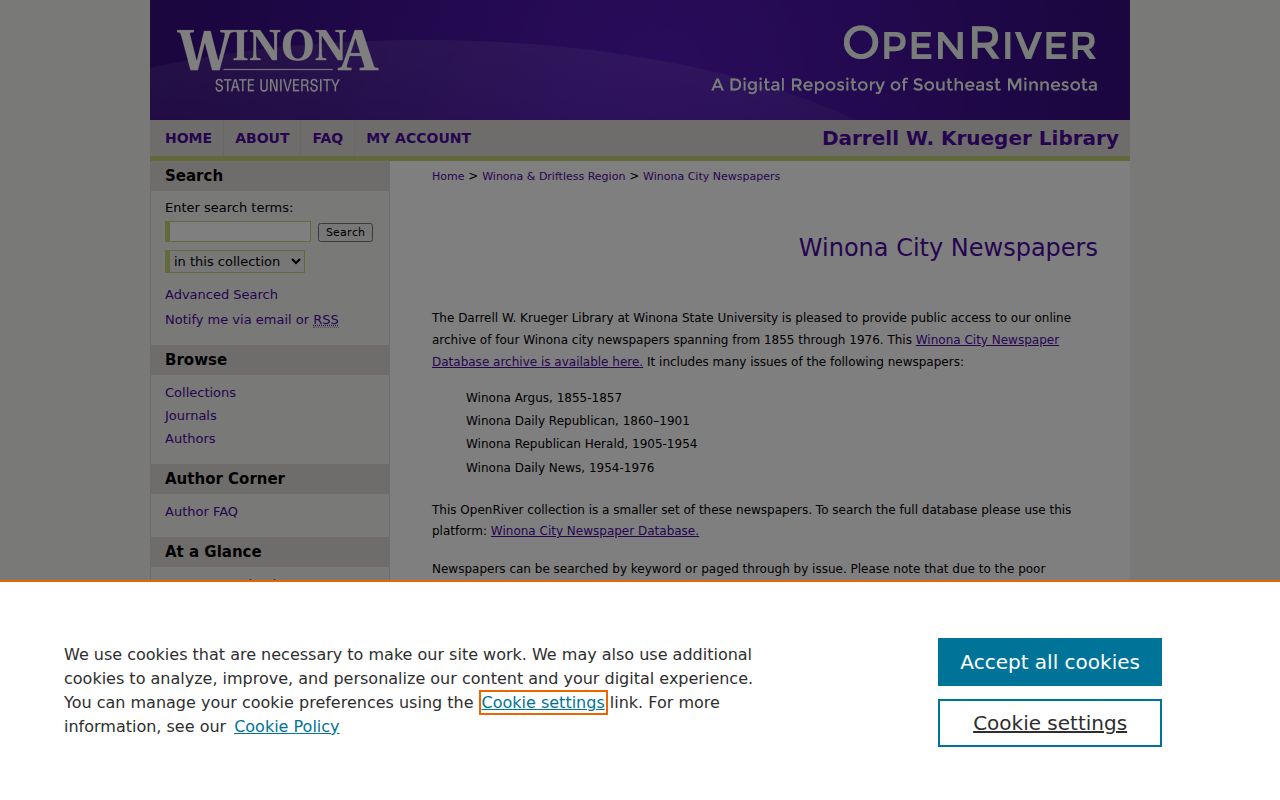
Use the issue view to check a result whose spelling or date looks uncertain, then record the paper title and publication date alongside the directory year.
OpenRiver identifies the Argus for 1855-1857, the Daily Republican for 1860-1901, the Republican Herald, and the Daily News into 1976. Winona County Historical Society describes a slightly different boundary for the Republican Herald, so verify a title transition in the archive itself. This is a practical comparison between free OCR search and Winona Public Library's longer microfilm run: each fills a different gap.
Winona Public Library's obituary indexes cover 1960-1979, 1980-1999, and 2000-2010. Its article or obituary requests are one person or item at a time, generally use seven days from a death date, and are limited to three each month. The stated service window is one to four weeks. Minnesota residents are free; out-of-state requests cost $2 each.
Winona Archives Beyond Directories
Winona County Historical Society's Laird Lucas Library & Archives at the Winona County History Center keeps the wider local record around a household. Its reported holdings include Winona newspapers, city directories, vital statistics, cemetery material, plat maps, photographs, and business or organization papers. Archives visits are by appointment Monday through Wednesday through research@winonahistory.org or 507-454-2723 ext. 2. A nonmember visit costs $5 and includes the first 15 minutes; archivist assistance is $20 per hour.
The Winona County Historical Society research page is the source for its appointment route and its historical collections.

Ask whether a relevant Winona box, map, organization file, or directory volume is available before arranging paid assistance. Winona County Historical Society also makes more than 800 local-history items available through its Minnesota Digital Library and MN Collections presence.
Winona Public Library adds in-house Ancestry Library Edition, yearbooks, obituary indexes, and The Resting Places of Winona County. These companion sources can support an older Winona household trail, but a private membership list or a modern work contact does not become a resident record merely because a name appears there.
Reading a Winona City Directory Entry
Winona historical entries are compact and their fields differ by year. The available research did not include a browser-visible page from a Winona volume, so the inventory below is a Winona reading checklist rather than a claim that every entry contains every field. Photograph or transcribe the volume's own abbreviation key before interpreting a letter or symbol. It is often the difference between a solid household connection and an overconfident guess.
| Name string | Record the Winona volume's surname, given name, initials, and exact spelling. |
|---|---|
| Household clue | A spouse may appear in parentheses, and a widow notation may connect an entry to a prior household. |
| Occupation or affiliation | Some entries include an occupation, business association, or both. Use it only as a matching detail. |
| Street address | Capture the Winona house number and street exactly, then compare it with the next and prior volume. |
| Ownership notation | Some editions may use owner or non-owner marks. Read the key in that same volume before assigning meaning. |
| Source detail | Keep the title, year, publisher, page number, and any cross-reference with the transcription. |
- Criss-cross directory
- A directory arranged by address or street rather than alphabetically. No separately titled Winona reverse or criss-cross run was verified, so ask whether a particular volume contains a street section.
- Householder index
- An index that groups a dwelling under a household heading. Its presence in a given Winona volume must be confirmed from that volume.
- Abbreviation key
- The volume's own explanation of shortened words or symbols. Preserve it before drawing a conclusion from an entry.
Winona Directory Name Variants
Winona has an unusually useful set of historic place-name variants. The historical society explains the Dakota name Winuŋna and notes Wenonah, Weenona, and Wynona. Older sources can also use Island City, Wabasha's Prairie, or Wing Prairie. Those forms are search aids for newspapers, cemetery references, naturalization material, and catalog descriptions. They do not prove that two people with a similar name are the same person.
Try the Winona place variants beside initials, maiden and married surnames, or a street abbreviation when an OCR search fails. That small local quirk often retrieves a Winona page that a modern spelling leaves behind. Note: A surname match still needs an address, spouse, age, occupation, or document relationship before it is treated as one person.
Tracing Winona Directory Households
A Winona household trail works best in short steps. Find the likely name in one volume, move forward and backward a single available year at a time, and keep each Winona address change. Search both the alphabetical name section and any available street section. A directory address may point to a business or boarding location, so pair it with the surrounding evidence instead of treating it as a final conclusion.
- Choose the closest available directory year and save the exact entry, title, publisher, and page.
- Check the preceding and following volumes for changed initials, spouse notation, affiliation, or address.
- Ask WPL or WCHS whether the volume has an address-order section when the street itself is the stronger lead.
- Pair the years with federal census material and Minnesota's state census years, then compare the age, household, and place details.
- Use a Winona newspaper, obituary index, cemetery source, deed, or archive request to test a disappearance from the run.
A person can appear in a Winona directory but not in a later census because the sources were compiled at different times. A disappearance can reflect a move, death, unlisted status, or a changed spelling. The best Winona trail keeps each possibility open until an original record narrows it.
Winona Directory Census Gaps
The Minnesota Historical Society genealogy gateway provides Winona state-census checkpoints for 1865, 1875, 1885, 1895, and 1905, plus birth and death indexes. Its Winona finding aid also describes incomplete local registers, including a likely lost or incomplete Winona birth register for 1897-1901. These are useful checkpoints when an expected name is absent from a Winona listing, but an index entry is not the same thing as a certified record.
The Minnesota Digital Library's Winona Public Library collection gateway points toward digitized local material such as blueprints, photographs, board minutes, an 1857 city map, and late-1870s commencement programs.
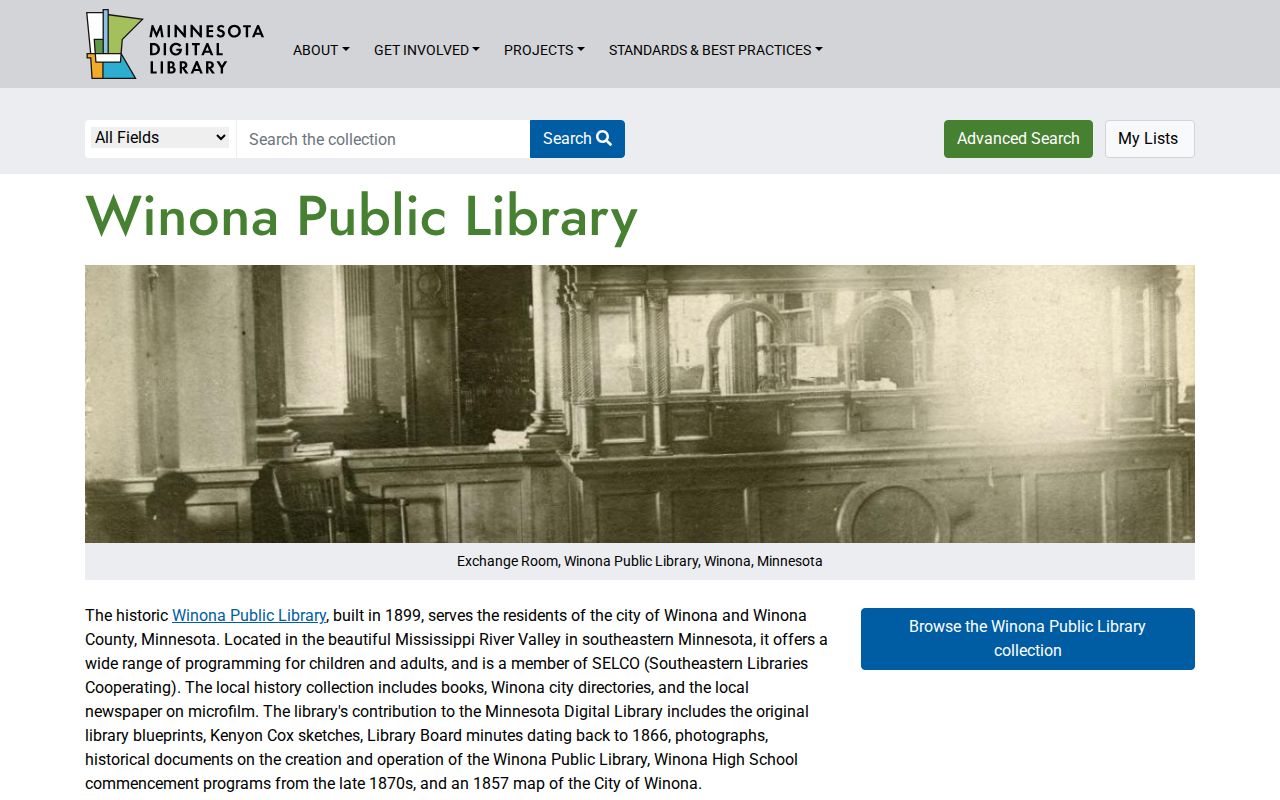
The gateway is useful Winona context, not proof that a dedicated digitized Winona directory series is online. The research did not locate such a dedicated directory page, so WPL and WCHS remain the proper contacts for a requested volume.
Winona City Directory Limits
Winona directory volumes, newspaper OCR, and archive catalogs all contain gaps. WPL reports missing directory years, OpenRiver notes imperfect text recognition and missing issues, and WCHS holdings require an appointment for Winona archives work. The Minnesota Government Data Practices Act presumes government data public unless another law classifies it differently, but that law does not make every historic Winona file unrestricted. Adoption and certain birth material have documented 100-year limits, and current protected Winona addresses must remain protected.
When a catalog or scanned page conflicts with another source, retain the citation and ask the custodian for the original context. For modern address-keyed records, use the Winona Streets reference rather than trying to make a historical listing answer a current parcel question.